
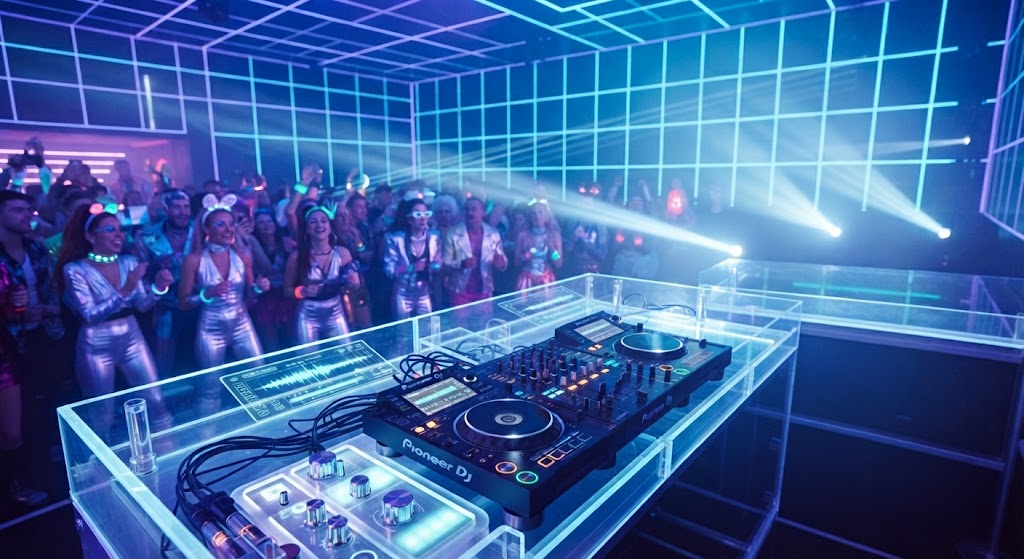
Behind the Booth: To the untrained eye, the DJ booth or the producer’s studio looks like a playground of flashing lights, endless knobs, and high-end gear. People see the hands in the air, the drop hitting at midnight, or the finished master streaming on Spotify. But if you ask anyone who spends their life behind the booth, they’ll tell you a very different story.
Behind the Booth is where the real work happens. It’s the space where the meticulous, often solitary world of audio engineering collides with the pulsating, unpredictable energy of a live crowd. Whether you’re dialing in low-end punch on an Ableton channel strip, tightening up a groove for a soulful house release, or managing the flow of a live set, the magic lives in the details.
Let’s pull back Behind the Booth the curtain and look at what it really takes to bridge the gap between technical craft and raw human emotion.
The Studio: Sculpting the Foundation
Before a track ever moves a crowd, it has to survive the DAW. For me, the studio is a laboratory of precision. This is where engineering rules supreme, and every single decibel matters behind the booth
Take low-end management, for instance. Getting that sub-bass to sit right with the kick drum isn’t just about turning up the volume; it’s a delicate dance of EQ, sidechain compression, and phase alignment. If I’m working on a soulful house track, the groove is everything. I might spend hours micro-editing the timing of a hi-hat or swinging a percussion loop just a few milliseconds to get that organic, head-nodding bounce.
In the studio, you are your own toughest critic. You’re carving out space for every element—making sure the vocals breathe, the mids have warmth, and the transient of the snare cuts through without fatiguing the ear. It’s clinical, detail-oriented work. But you do all of that meticulous engineering for one specific reason: to give the music the power it needs to translate outside of your headphones.
The Transition: From Canvas to Crowd
The moment you take that polished studio creation—or someone else’s masterpiece—and load it onto a USB or pull it up for a live set, the dynamic shifts entirely.
In the studio, you control time. You can undo a mistake, mute a track, or spend twenty minutes tweaking a reverb tail. Behind the booth at a venue, time is a living, breathing river. You are no longer just an engineer; you are a conductor, a psychologist, and a curator all at once.
Reading a dance floor is an art form rooted in empathy and observation. You watch the front row, you scan the edges of the room, and you listen to how the sound system interacts with the architecture of the space. You might have planned a rigid setlist, but if the energy in the room dips, you have to pivot instantly.
The Synthesis: Where the Magic Happens
The real breakthrough in my own workflow happened when I stopped treating production and DJing as two separate disciplines. They feed each other constantly.
When you understand how a track is engineered—how the frequencies are layered, where the headroom sits, and how the dynamics are controlled—you mix differently in a live set. You stop relying solely on the mixer’s EQ to fix a muddy transition because you can hear why two tracks are clashing structurally.
Behind the Booth: Conversely, playing live changes how you produce. When you’ve stood behind a booth at 2 AM and watched a crowd react to a sudden drop in percussion, or felt the collective gasp when a massive sub-bass rolls through the room, you carry that feeling back into the studio. You stop over-compressing. You leave room in your arrangements because you remember that a track needs space to breathe when it’s being blasted through a massive club system.
It’s All in the Details
At the end of the day, whether I’m staring at a computer screen at dawn or watching strobe lights reflect off a mixer at midnight, the core mission is the same. It’s about connection.
Behind the Booth: The technical precision—the plugins, the gain staging, the beatmatching, the harmonic mixing—is just the vocabulary. The story you tell with it is what moves people. So much of that story lives in the margins: the subtle automation sweep, the unexpected track selection, the micro-adjustment of a fader just as the kick drops.
Behind the Booth: Stepping behind the booth isn’t about ego or the spotlight. It’s about rolling up your sleeves, respecting the craft, and losing yourself in the details so everyone else can lose themselves in the music.